Mondo Knows Facts
Igor Sikorsky designed the first practical single-rotor helicopter in 1939
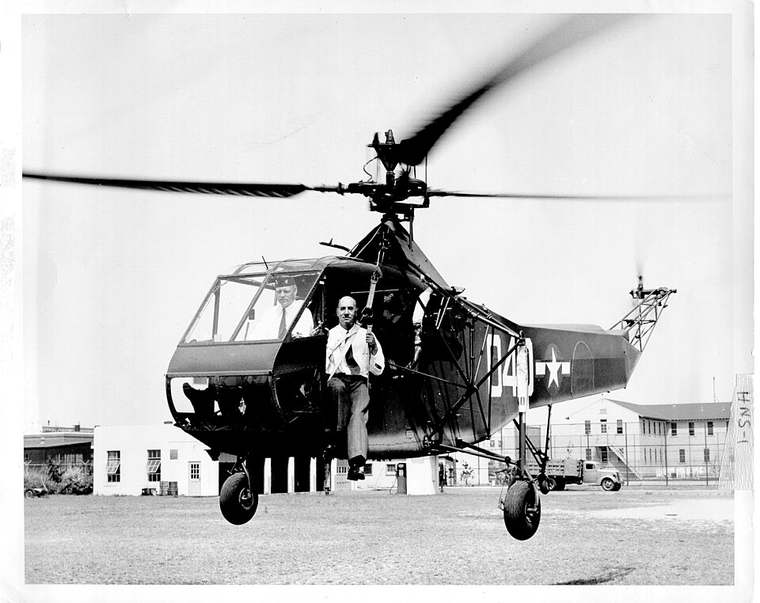
The VS-300 featured a main rotor for lift and a tail rotor to counteract torque Aviation pioneer Igor Sikorsky designed and flew the Sikorsky VS-300 in Stratford, Connecticut, in September 1939. His design resolved rotational torque using a small vertical tail rotor pushing sideways against main rotor torque. This single main rotor with tail rotor configuration became the standard mechanical setup for modern helicopters. It sits in Mondo's technology collection, one of 200 facts that each trace back to the reference below.
Where this comes from
Facts that can change over time are reviewed and updated. If something here looks wrong, Mondo would rather know than be confidently incorrect.
Go further
More facts like this
 TechnologySonic booms occur when aircraft travel faster than the speed of soundAir pressure waves compressed at Mach one coalesce into continuous shock wavesTechnologyMost of a turbofan's thrust comes from cold airA large fan pushes air past the engine core, and modern airliners move several times more of it than the core burnsTechnologyWinglets cut the drag made by wingtip vorticesTurning the wingtip upward weakens the swirling vortex and can trim fuel burn by several percentTechnologyETOPS rules measure how far a twin may strayTwin engine airliners are cleared in minutes of flying time from a usable diversion airport, not in distance
← → to keep reading, or swipe
Tags: aviation, helicopter, sikorsky
Igor Sikorsky designed the first practical single-rotor helicopter in 1939: the short answers
- Where does this come from, and can I check it?
- The VS-300 featured a main rotor for lift and a tail rotor to counteract torque. The figure is taken from Sikorsky Archives, which is linked in full on this page. Every fact on Mondo Knows names its source rather than repeating an unsourced claim.
- Is this really a technology fact?
- Yes. It sits on the Technology shelf, one of 2,600 sourced facts grouped into space, animals, the human body, history, science and more. Category pages collect every fact in the same field.
- What else can I read about it?
- The links under the fact point to a quiz, game, puzzle or calculator on the same subject, and the shelf below shows related facts. The wording here is original, and quoted phrases are marked as quotations.