Mondo Knows Facts
The Kepler Space Telescope discovered thousands of exoplanets
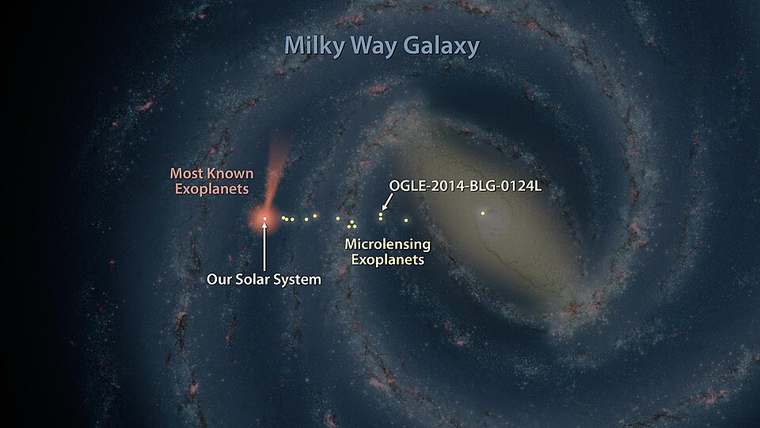
Monitoring star brightness dips revealed worlds orbiting distant stars Launched in 2009, NASA's Kepler Space Telescope monitored over 150,000 stars simultaneously for tiny periodic dimmings caused by orbiting planets crossing their stellar discs. During its 9-year mission, Kepler identified over 2,600 confirmed exoplanets, demonstrating that planets outnumber stars in our galaxy. It sits in Mondo's space collection, one of 200 facts that each trace back to the reference below.
Where this comes from
Facts that can change over time are reviewed and updated. If something here looks wrong, Mondo would rather know than be confidently incorrect.
Go further
More facts like this
SpaceSome planets orbit two suns at onceKepler-16b circles a pair of stars that also eclipse each other SpaceThe Spitzer Space Telescope peered through interstellar dust cloudsThermal infrared detectors imaged cold dust planet birth and faint starsSpaceA planet crossing its star dims the lightThe size of the dip gives the planet's radius compared with its star'sSpaceWobbling starlight reveals unseen planetsA star's tiny back and forth motion shifts its spectral linesSpaceRogue planets wander the galaxy without a starGravitational scattering can fling worlds into interstellar space on their own
 SpaceTRAPPIST-1 hosts seven Earth-sized rocky planets around an ultracool starThree planets in the system orbit within the habitable liquid water zone
SpaceThe Spitzer Space Telescope peered through interstellar dust cloudsThermal infrared detectors imaged cold dust planet birth and faint starsSpaceA planet crossing its star dims the lightThe size of the dip gives the planet's radius compared with its star'sSpaceWobbling starlight reveals unseen planetsA star's tiny back and forth motion shifts its spectral linesSpaceRogue planets wander the galaxy without a starGravitational scattering can fling worlds into interstellar space on their ownSpaceTRAPPIST-1 hosts seven Earth-sized rocky planets around an ultracool starThree planets in the system orbit within the habitable liquid water zone🪐 Spacefact 79 of 200
← → to keep reading, or swipe
Tags: kepler, exoplanets, telescope
The Kepler Space Telescope discovered thousands of exoplanets: the short answers
- Where does this come from, and can I check it?
- Monitoring star brightness dips revealed worlds orbiting distant stars. The figure is taken from NASA Science, which is linked in full on this page. Every fact on Mondo Knows names its source rather than repeating an unsourced claim.
- Is this really a space fact?
- Yes. It sits on the Space shelf, one of 2,600 sourced facts grouped into space, animals, the human body, history, science and more. Category pages collect every fact in the same field.
- What else can I read about it?
- The links under the fact point to a quiz, game, puzzle or calculator on the same subject, and the shelf below shows related facts. The wording here is original, and quoted phrases are marked as quotations.